How to Use Neem for Skin: DIY Pastes, Toners and Spot Treatments That Actually Work
📅 Last reviewed: March 2026
The neem tree grows in almost every Indian neighbourhood, its distinctively bitter leaves and the faint medicinal smell in the air around it as recognisable as any landmark. For most people who grew up in India, neem is somewhere in the background of childhood memories — a grandmother making a face paste with it, leaves being added to bath water during chickenpox, a twig being used as a toothbrush. The familiarity has bred a comfortable kind of indifference. Neem is just there, available, and mostly underused.
Modern pharmacology has spent considerable effort understanding what the Ayurvedic tradition claimed for centuries: that Azadirachta indica — the neem tree — is one of the most pharmacologically active plants in the natural world, with documented antibacterial, antifungal, antiviral, anti-inflammatory and antiparasitic properties arising from over 130 distinct biologically active compounds. For skin specifically, this translates into one of the most complete natural treatments available for acne, fungal infections, seborrheic dermatitis, and inflammatory skin conditions.
Here is how to actually use it — in forms that deliver these benefits to skin effectively.
What neem does to skin — the active compounds and their effects
Neem’s primary active compounds for skin use are:
- Azadirachtin: The most studied neem compound — potent antibacterial and antiparasitic, disrupts bacterial cell reproduction
- Nimbin and nimbinin: Anti-inflammatory compounds that inhibit COX-2 and reduce prostaglandin production — directly reducing the redness and swelling of acne inflammation
- Gedunin: Antifungal compound effective against Candida and Malassezia (the yeast associated with dandruff and seborrhoeic dermatitis)
- Quercetin: Flavonoid antioxidant with anti-inflammatory and skin-barrier-strengthening properties
- Fatty acids (oleic, stearic, palmitic): Primarily in neem oil — these support the skin barrier and have some comedolytic (pore-clearing) activity
In practical terms: neem kills acne-causing bacteria, reduces the inflammation associated with active breakouts, addresses the fungal component of dandruff and seborrhoeic dermatitis, and — with consistent use — reduces the frequency of breakouts by maintaining a healthier microbial balance on the skin surface.
The three forms of neem for skin — and when to use each
Fresh neem leaves — most potent, best for acute treatment
Fresh leaves contain the full spectrum of volatile compounds at their highest concentration. The compounds in neem that are most affected by processing are the volatile terpenoids — these begin degrading within hours of the leaf being removed from the tree. Fresh neem provides these at maximum potency.
Use fresh neem when: you have access to a neem tree, you need acute antibacterial action (active acne breakout, skin infection), or you are making a preparation for immediate use.
Neem powder — most convenient, suitable for regular use
Properly shade-dried and ground neem powder retains most non-volatile compounds (including azadirachtin in significant quantity) and is shelf-stable, easy to portion, and mixable with any carrier. It has slightly less immediate potency than fresh leaves but is far more practical for regular use. Look for dark green, fine powder with a strong, distinctively bitter smell — pale or yellowish powder indicates heat-dried product with degraded actives.
Neem oil — highest concentration, for targeted use only
Cold-pressed neem oil is extracted from neem seeds and is extraordinarily concentrated — it contains the highest density of neem’s active compounds of any form and has a correspondingly powerful smell (described variously as sulphurous, garlicky, and deeply medicinal). It must always be diluted before skin application. Undiluted neem oil can cause severe irritation and chemical burns on sensitive skin.
Neem oil’s high concentration makes it the best choice for targeted spot treatment of stubborn acne, fungal patches, or infected areas — but it is too strong for whole-face application in most people.
DIY neem recipes for skin — with specific instructions
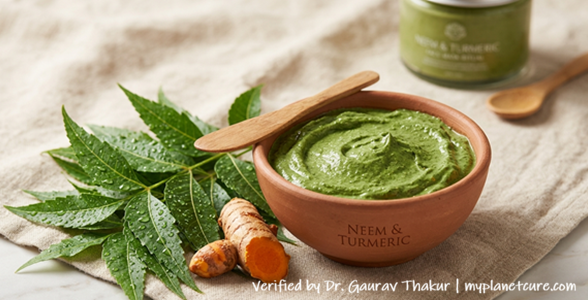
Recipe 1: Fresh neem leaf paste for acne and oily skin
This is the most traditional and direct application — a simple paste of ground fresh leaves applied as a targeted treatment or light all-over mask.
What you need:
- 15–20 fresh neem leaves, washed
- A small amount of water (just enough to blend)
- Optional: 1 teaspoon turmeric for enhanced anti-inflammatory action
- Optional: 1 teaspoon multani mitti for additional oil absorption
Method: Blend or crush neem leaves with minimal water to a smooth paste. The paste should be dark green and intensely fragrant. Apply to the face (or acne-affected area) and leave for 15–20 minutes. The paste will dry to a dark green layer — this is normal. Rinse with cool water. Your skin will smell of neem briefly — this fades within an hour.
For targeted spot treatment: Apply only to active pimples or infected areas with a cotton bud. Leave overnight. Rinse in the morning. This concentrated application on individual spots is one of the fastest natural spot treatments available.
Frequency: 2–3 times weekly for oily or acne-prone skin as an all-over mask. Daily as a spot treatment on active breakouts until they resolve.
Recipe 2: Neem powder and yoghurt mask for inflamed acne
Inflamed, cystic acne benefits from the combination of neem’s antibacterial action with lactic acid’s (from yoghurt) gentle exfoliation and the cooling, anti-inflammatory effect of cold yoghurt on inflamed tissue. Yoghurt also moderates the intensity of neem for people with sensitive skin who find the straight neem paste too strong.
What you need:
- 1 teaspoon neem powder
- 2 tablespoons plain full-fat yoghurt (homemade or unsweetened — sugared yoghurt feeds bacteria)
- Optional: 2–3 drops of tea tree oil for severe acne
Method: Mix neem powder into yoghurt until smooth. Apply in an even layer, leave 15 minutes. Rinse with cool water. The lactic acid in yoghurt works simultaneously on surface exfoliation while the neem addresses bacterial load.
Frequency: Twice weekly for active acne; once weekly for maintenance.
Recipe 3: Neem water toner for daily use
This is the mildest and most daily-use-appropriate form of neem for skin — a lightly medicated water that captures neem’s antibacterial and anti-inflammatory properties in a concentration suitable for daily toning after cleansing.
What you need:
- 20–25 fresh neem leaves (or 1 tablespoon neem powder)
- 500ml filtered water
- Optional: a few drops of rose water to temper the smell
Method: Bring water to a boil, add neem leaves, simmer on low heat for 10 minutes. Cool completely. Strain into a clean glass bottle. Refrigerate — keeps for 5–7 days. Apply with a cotton pad after cleansing as a daily toner, or spritz on the face as a mid-day refresh. The concentration is mild enough for daily use for most skin types, including sensitive skin (though patch test first).
Storage tip: Make a fresh batch twice weekly. Do not use if the liquid becomes cloudy or develops an off smell.
Recipe 4: Neem oil spot treatment for stubborn acne
For the persistent, deep, cystic pimples that surface treatments cannot fully reach, diluted neem oil applied directly and left overnight provides a sustained antibacterial environment at the site.
What you need:
- Cold-pressed neem oil
- Jojoba or sweet almond oil as carrier
- Dilution ratio: 2–3 drops neem oil per 10ml carrier oil (approximately 2–3% concentration)
Method: Mix the dilution in a small bottle. Using a clean cotton bud, apply one drop of the diluted mixture directly to each active pimple. Do not apply to surrounding healthy skin at this concentration. Leave overnight. Rinse gently in the morning. Use consistently on the same spots for 3–5 nights.
Important: Never apply undiluted neem oil directly to skin, particularly on the face. The concentration will cause irritation, redness, and potentially chemical burns in sensitive areas.
Recipe 5: Neem and coconut oil body treatment for fungal conditions
Fungal skin conditions — tinea versicolor (white patches), athlete’s foot, ringworm, pityriasis — respond well to neem’s antifungal compounds, particularly gedunin, which has documented activity against several dermatophyte fungi. Coconut oil’s lauric acid adds complementary antifungal action and serves as a skin-conditioning carrier.
What you need:
- Cold-pressed neem oil: 5ml
- Cold-pressed virgin coconut oil: 50ml
- Optional: 3–4 drops of tea tree oil for additional antifungal activity
Method: Warm coconut oil slightly if solid. Mix all oils together. Apply to affected areas twice daily — morning and evening. Leave on; no need to rinse. Continue for minimum 4 weeks for fungal conditions — fungal infections require sustained treatment to prevent recurrence.
Neem for scalp and hair — the overlap with skin care
The same compounds that make neem effective for facial acne are equally relevant for scalp conditions driven by the same organisms. Dandruff caused by Malassezia yeast responds to neem’s antifungal compounds. Scalp folliculitis (infected hair follicles) responds to its antibacterial action. A neem leaf boil used as a final hair rinse after shampooing — the traditional grandmother’s method — has genuine efficacy for persistent dandruff and scalp itching.
Neem oil added to a carrier oil for scalp massage (5 drops per 30ml of coconut or sesame oil) delivers antifungal and antibacterial actives directly to the follicles in a sustained way.
Important precautions when using neem on skin
- Pregnancy: High doses of neem have traditional contraindications during pregnancy. External topical use of diluted preparations is generally considered safe, but concentrated neem oil on large areas of skin should be avoided during pregnancy. Consult your doctor.
- Very sensitive skin: Neem’s strong compounds can cause contact dermatitis in sensitive individuals. Always patch test behind the ear or on the inner wrist before applying to the face.
- Around eyes: Never apply neem preparations near the eyes — the concentrated bitter compounds cause intense irritation if they make contact with mucous membranes.
- Children: Diluted neem water rinses for skin conditions are traditional in Indian households for children. Concentrated preparations should be used with caution and in very small amounts.
Frequently asked questions about neem for skin
Can neem remedy cystic acne?
Neem significantly reduces the bacterial and inflammatory components of acne — including cystic acne — and with consistent use can dramatically reduce frequency and severity. Severe cystic acne with hormonal drivers benefits from neem as part of a broader treatment approach that may include medical care. Neem addresses the skin environment; it cannot correct underlying hormonal causes.
How long before neem shows results on acne?
Acute spot treatment (direct neem paste or diluted oil on active pimples) typically shows visible reduction within 2–3 days. For overall reduction in breakout frequency through regular use, most people see meaningful improvement within 4–6 weeks.
Does neem dry out skin?
Fresh neem leaf paste and neem water toner are mild enough not to dry most skin types. Neem powder masks and neem oil can be more drying — always follow with appropriate moisturisation. In the recipes above, yoghurt and oil additions are specifically included to prevent excessive drying.
Start with the toner — it is the most accessible neem habit
Of all the recipes above, the neem water toner is the best starting point: easy to make, mild enough for daily use, effective enough to produce noticeable improvements in skin clarity within 2–3 weeks of consistent use.
From there, add the fresh paste or powder mask twice weekly. Reserve the neem oil for targeted spot treatment when needed.
For how neem fits into a complete natural skin care routine, see our guide to natural skin care for Indian skin. For combining neem with multani mitti for oily and acne-prone skin, see our multani mitti face pack guide.
This article is for informational and educational purposes only. It is not medical advice. For persistent or severe skin conditions, please consult a qualified dermatologist.
For traditional Ayurvedic guidelines and further reading, explore the official resources provided by the Ministry of Ayush or research at the National Institutes of Health (NIH).